
Our United Kingdom IPTV Service for British Viewers
Want live television and on-demand programmes on the devices you already use at home? Our united kingdom iptv service brings those viewing options together, so you can consider one subscription for different screens and routines.
We offer live viewing, on-demand entertainment and a choice of subscription lengths. Your experience depends on the quality of your connection, the player you use and the content available to your household. We can help you compare those features and choose a suitable option, rather than assume one plan fits everyone.
Before paying, check the provider’s terms and whether it has the rights to distribute the content you want. A large catalogue or familiar channel name does not, by itself, confirm those rights. The service features and catalogue overview below offer a starting point for deciding what matters to you.

Key Takeaways
- We list live television and on-demand movies and series.
- Check connection quality and player compatibility before subscribing.
- Compare each plan’s term with the number of screens streaming at the same time.
- Use the free trial to test your own devices and viewing habits.
- Confirm content permissions and service terms before paying.
What Our United Kingdom IPTV Service Includes
Our service lists more than 20,000 live channels and more than 100,000 on-demand movies and series. The catalogue includes sport, films, children’s programming, news, documentaries and international entertainment, giving households different kinds of viewing to explore.
The listed figures describe catalogue size, not guaranteed access to a particular channel, event or programme. Live channels carry scheduled broadcasts, while on-demand titles can be selected and played when available. The phrase live channels on-demand can blur those two formats, so check whether a specific title is offered live or on demand.
A large catalogue does not guarantee that a particular channel, event or programme is available or appropriately licensed.
Availability can vary, and a familiar programme name is not proof that the provider can distribute it. We encourage viewers to check the content they care about during a trial, then read the service terms before choosing a subscription.
Think about the household’s actual viewing: live news, a children’s programme, a film night or international entertainment. This helps you judge whether the provider’s catalogue is useful, rather than relying on the headline number alone.
Those choices also depend on how the content reaches your screen. Before deciding on a plan, consider the broadband connection and compatible player needed for streaming.
How IPTV Works and What You Need
A live programme can load through home broadband instead of arriving through a satellite dish or cable line. IPTV is television delivered over an internet connection, and the connection carries the stream to a compatible device.
A steady connection and suitable player are essential, but neither guarantees smooth playback. An M3U playlist is a file containing links to television streams that a compatible player can load. Other household use, Wi-Fi quality and the number of screens streaming at the same time can all affect results.
The broadband connection for HD and 4K
Our setup guidance gives 10 Mbps as a connection guide for HD and 20 Mbps for 4K. These are per-stream figures, not a promise of performance. Several people watching at once, video calls or downloads can use some of the same bandwidth.
A wired connection may avoid some Wi-Fi interruptions, while a distant router or busy wireless network can affect picture quality. The technology can deliver different picture formats, but the result depends on the service, device and home network together.
Choosing a compatible player
A compatible player reads the stream links or login details and presents available programmes. Check that the player works with your device and operating system before you subscribe. You do not need a dish, but you do need a device that can access the service through a supported player.
- Available broadband speed for each stream
- Wi-Fi or wired connection quality
- A compatible player for your device
- How many people may stream at once
Once you have checked those basics, compare the subscription length with the number of screens your household may use together.
Plans, Prices and Screen Options
The offer has three fixed terms and one lifetime option, with listed prices in pounds sterling. Each plan also sets the number of simultaneous connections, meaning the screens streaming at the same time.
The fixed-term options run for three, six or twelve months; the lifetime option is a different commitment. The listed prices and connection allowances are shown here for comparison.
| Plan | Term | Listed price | Connections |
|---|---|---|---|
| Starter | 3 months | £19.99 | 2 |
| Premium | 6 months | £29.99 | 3 |
| Pro | 12 months | £45 | 4 |
| Ultimate | Lifetime | £350 one-time | 5 |
The Starter option has the shortest term and fewest connections. The longer fixed plans provide more connections, while the lifetime option lists five. A connection allowance is not the same as a promise that every screen will play without interruption.
Lifetime access differs from renewing a fixed-term subscription. The listed price is a one-time payment, so read the service terms carefully to understand what lifetime means, what is included and what happens if the service changes.
Payment methods and any conditions attached to a plan should be clear before checkout. Do not assume that the lowest listed total or longest term is automatically the right choice for your household.
Compare the term and screen allowance with your likely viewing habits. That makes it easier to choose a plan that suits both your budget and the number of viewers.
Which Plan Fits Your Household?
A household with one login but three people watching different programmes may need several screens streaming at the same time. Start with that real pattern, rather than choosing the most expensive subscription by default.
The best IPTV choice is a tested, suitably licensed service with an allowance that matches your household. A shorter commitment can limit how long you are tied to a service while you assess it. Longer terms have a lower listed total than buying repeated short terms, but they require a bigger commitment upfront.
Choosing a term that suits your budget
Consider how long you need to judge the service and whether you are comfortable paying for a longer period. A lower listed total can be attractive, but it does not help if the catalogue, player or support fails to meet your needs.
Compare providers on more than headline catalogue size. Look at the terms, content permissions, response routes and the way the service performs on your own connection. Those checks make it easier to choose IPTV with fewer assumptions.
Matching connections to the number of viewers
Count the screens likely to stream together, not just the number of people with login credentials. One viewer may switch between a phone and television, while several household members may want separate programmes at the same time.
Use this decision checklist before selecting a plan:
- How long you will test the service
- Your household’s usual viewing habits
- How many simultaneous screens you need
- Whether you accept the lifetime term
Different IPTV services and providers set different terms, so read the chosen offer rather than relying on general assumptions. Use the free trial to test the experience before committing to a term.
How to Use the Free Trial and Review the Service
Imagine checking a familiar live channel during your usual evening viewing period. A 24-hour free trial lets you assess the service in practice, with full access and no credit card required.
The trial lasts 24 hours and does not require card details. It gives you time to check the channels and playback that matter to you, but it does not promise that every channel or event will be available.
What the 24-hour trial includes
Use the trial to judge whether the service suits your own equipment and viewing routine. A United Kingdom IPTV review should focus on practical use over your connection, not an unverified channel count. Notice whether your chosen content is available and whether playback is comfortable to watch.
Keep a note of any issue, including the channel name, device and time. A clear example helps support understand what happened, rather than asking them to investigate a vague report of poor quality.
How to test at the time you usually watch
Evening use may differ from a quiet afternoon, especially when other people at home are online. Test during the period when you normally watch, then decide whether the picture and start-up time meet your expectations.
- Open channels the viewer actually watches.
- Check channel start-up and picture stability.
- Test during the viewer’s usual busy viewing period.
- Contact support with a real setup question.
These checks make the trial more useful than simply scrolling through channel names. Ask a practical question about your setup and note whether the answer helps you act.
The trial can reveal how the service performs, but only on compatible equipment. Next, confirm that your device and preferred player can run it.
Supported Devices and IPTV Players
If you already own a Fire TV Stick or Smart TV, check whether it can run a compatible player. The listed devices include televisions, streaming boxes, phones and computers, so a separate box may not be necessary.
Player availability depends on the device and operating system, so confirm compatibility before purchase. A united kingdom IPTV Firestick search may help identify setup options, but the app store on your specific model is the practical check.
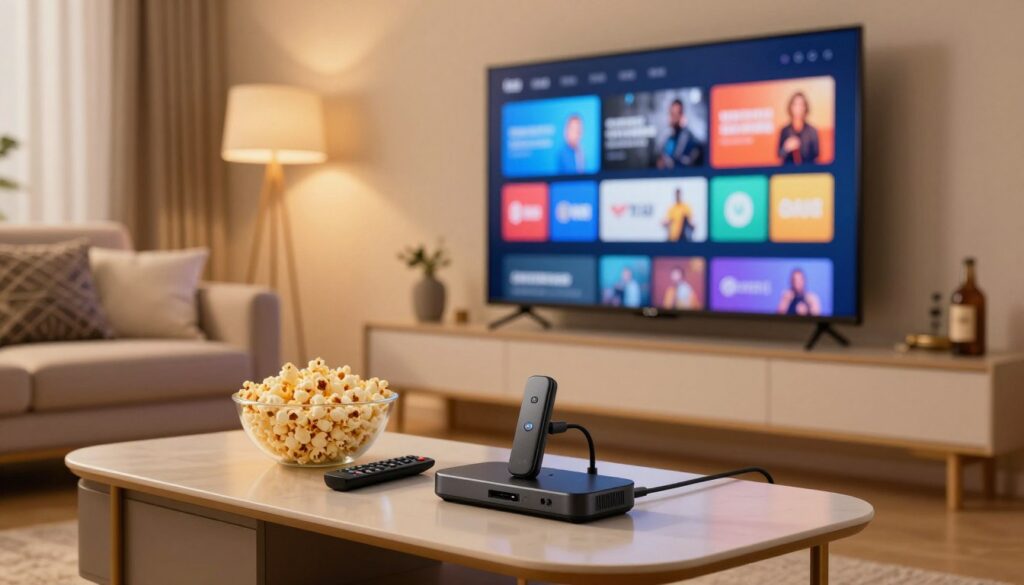
Fire TV Stick, Smart TVs and Android devices
Smart TVs, Fire TV Stick devices and Android TV boxes are listed as compatible. Android phones are also included. A united kingdom IPTV player may be IPTV Smarters, TiviMate, IBO Player, or another player supporting M3U or Xtream Codes.
Not every player works on every television or box. Check the exact model and operating system, then confirm that the selected player supports the login method you expect to use.
Phones, computers and other boxes
The listed options also include Apple TV, iOS devices, Windows and Mac computers, set-top boxes and media players. This range can make it easier to use equipment you already have, though access still depends on an app or player being available.
| Device group | Listed examples | Compatibility check |
|---|---|---|
| Televisions and Fire TV Stick | Smart TV and Fire TV Stick | Confirm the chosen player is available |
| Android devices | Android phone and Android TV box | Use a compatible player |
| Apple and computer devices | Apple TV, iOS, Windows and Mac | Confirm app and credential support |
Check the player’s availability and support for your device before paying. Once you know your equipment can run it, you can move on to receiving and entering login details.
How to Activate Your IPTV Login
After you complete an order, the listed setup process sends login details by email and WhatsApp within minutes of payment. The united kingdom IPTV login is then entered into a compatible player to access the service.
The setup guidance estimates activation at under 5 minutes. That is an estimate, not a guarantee: an app issue, incorrect detail or connection problem can extend the process. The united kingdom IPTV activation sequence is straightforward when the order details and player are ready.
Follow these steps after choosing a subscription:
- Choose the plan that suits your needs.
- Receive login credentials by email or WhatsApp.
- Enter the credentials in the player and test a channel.
Use the details exactly as sent, including any distinctions between capital and lower-case letters. If a channel does not load, check the entered credentials and player before contacting support with the error you see.
Keep the email or WhatsApp message available while setting up. It gives you a clear record of the login credentials and makes it easier to spot a typing mistake.
Once a channel plays, check the content you actually want to watch rather than treating a successful login as proof that every listing is available. You can then assess live and on-demand viewing for your household.
Live Channels, Sport and On-Demand Viewing
One viewer may prioritise live sport, while another wants films or series on demand. Begin with the channels and titles your household is most likely to watch, then check whether the service carries them.
Channel examples are checks for the viewer, not a guarantee of carriage or access to a particular broadcast. A listing may not confirm that a specific event or programme is available when you want it.

| Viewing type | Examples to check | What to confirm |
|---|---|---|
| UK general viewing | BBC One and BBC Two | Confirm whether the channels are included |
| Commercial and entertainment | ITV1 and Channel 4 | Check channel availability |
| Family and general entertainment | Channel 5 | Check regional or schedule variations |
| Live sport | Premier League and Champions League | Confirm event and rights availability |
| Other sport | Formula 1 and UFC | Confirm the specific event and availability |
For live channels, check whether the channel itself is included and whether the desired broadcast appears in its schedule. For live sports, check the specific fixture or event, since a league name alone does not confirm access.
For movies and series, try searching for a known title and see whether it is available on demand. A useful catalogue should match the household’s interests, not just display many categories.
Make your checks against the content you genuinely watch, including films, series and live sports. How reliably those streams play also matters, so consider the service’s uptime claims and support routes.
Streaming Reliability, Uptime and Support
A live event may load less smoothly at a busy viewing time than a quiet daytime programme. Streaming depends on more than the provider’s servers: home network quality, device performance and stream availability can all affect playback.
The advertised 99.9% uptime is not a guarantee of uninterrupted viewing. Uptime describes a service availability claim, not every viewer’s picture quality or access to every stream. Even when servers are operating, a weak home connection or a device problem can interrupt a programme.
Ask what the provider means by uptime and how it handles an outage. A figure on a service page does not explain how individual channels are monitored or what remedy applies when a stream fails.
Email and WhatsApp are listed as support routes. The six-month plan specifies 24/7 WhatsApp support, which is a plan-specific detail rather than a promise that every plan has the same response hours.
Before paying, ask what support hours apply to your chosen plan, how to report playback faults and what remedies may be offered. A useful response should address the device, channel and time of the problem, not simply repeat general setup advice.
Look at service terms as well as uptime language. Once you understand what can affect playback and where to ask for help, check content rights and UK viewing obligations before subscribing.
Licensing and Responsible Viewing in the UK
Using IPTV technology is not proof that a provider has the rights to distribute specific broadcasts. The technology and the content permissions are separate questions, and viewers should check both before paying.
A provider’s use of internet delivery does not establish that every channel or title is authorised for the UK. A professional-looking service page or a long catalogue cannot answer that question on its own.
IPTV technology does not prove that a provider has permission to distribute every broadcast or title.
Check the provider’s content permissions
Ask the provider for clear licensing information and check whether the named content is authorised for distribution in the UK. Read the service terms and refund conditions, including what happens if access or content changes.
Do not treat a channel name or successful stream as evidence of permission. If the answers are unclear, pause before paying and seek current information from the relevant official bodies.
Understand your own UK viewing obligations
UK TV Licence requirements depend on the viewing planned. Check current rules with the relevant official bodies rather than relying on a provider’s summary. This is a practical reminder, not legal advice.
- Ask for clear licensing information.
- Check that named content is authorised for the UK.
- Read the service terms and refund conditions.
- Confirm applicable UK TV Licence requirements for your planned viewing.
These checks apply to IPTV providers and other services carrying television content. If the permissions, terms and viewing requirements meet your needs, you can make a considered choice and take the final step with more confidence.
Conclusion
Judge the service through a real viewing test, not a headline claim. We recommend testing it on the device and connection you use most often, then confirming the plan’s screen allowance and licensing terms before paying.
A trial can show whether the streaming experience suits your home, while a compatibility question can help resolve uncertainty before you commit to a subscription. Choose the term only after you understand its conditions and the support available to you.
Request the 24-hour trial without providing card details, or contact support with a question about your device. Either step gives you something concrete to check before making a decision.
FAQ
What broadband speed should I have for HD or 4K streaming?
The service guidance gives 10 Mbps per stream for HD and 20 Mbps per stream for 4K. Those figures are guides, not guarantees of picture quality. Other household traffic, Wi-Fi conditions and screens streaming at the same time can require more capacity. Check performance where the device will be used, especially if several people share the connection.
Do I need to provide card details for the free trial?
No, the listed 24-hour free trial requires no credit card. You can use the trial to check the service on your own device and connection without entering card details for access. The trial does not guarantee that every channel or event will be available, so test the programmes you actually want to watch.
How many screens can I use on each plan?
The listed allowances are 2, 3, 4 and 5 connections for the 3-month, 6-month, 12-month and lifetime plans respectively. These numbers describe simultaneous connections, or screens streaming at the same time. Count how many viewers may watch separate programmes together, rather than counting login credentials or devices that are used at different times.
Can I use the service on a Fire TV Stick and a Smart TV?
Yes, both Fire TV Stick and Smart TVs are listed as compatible. You still need to confirm that a suitable player is available for the specific model and operating system. Player availability can differ between devices, so check this before paying. A device being listed does not mean every player or login method will work on it.
How long does activation take?
The setup guidance gives an estimate of under 5 minutes, with login details listed as arriving by email and WhatsApp within minutes after payment. That estimate assumes the player and connection work as expected. If an app has a problem or credentials are entered incorrectly, setup can take longer. Keep the login message available while entering the details.
Do I need to buy an IPTV box?
No, not necessarily. Listed compatible options include Smart TVs, Fire TV Stick, phones, computers and Android TV boxes. If you already own a suitable device, you may only need a compatible player. Check that the player supports your device and the service’s login method before you subscribe, rather than buying a separate box by default.
Is an IPTV service automatically licensed to show every channel?
No. IPTV describes television delivered over an internet connection; it does not establish a provider’s rights to distribute specific content. Ask for clear licensing information, check that the named content is authorised for the UK, and read the service terms. Confirm current viewing requirements with the relevant official bodies, since a channel listing alone proves nothing about permissions.